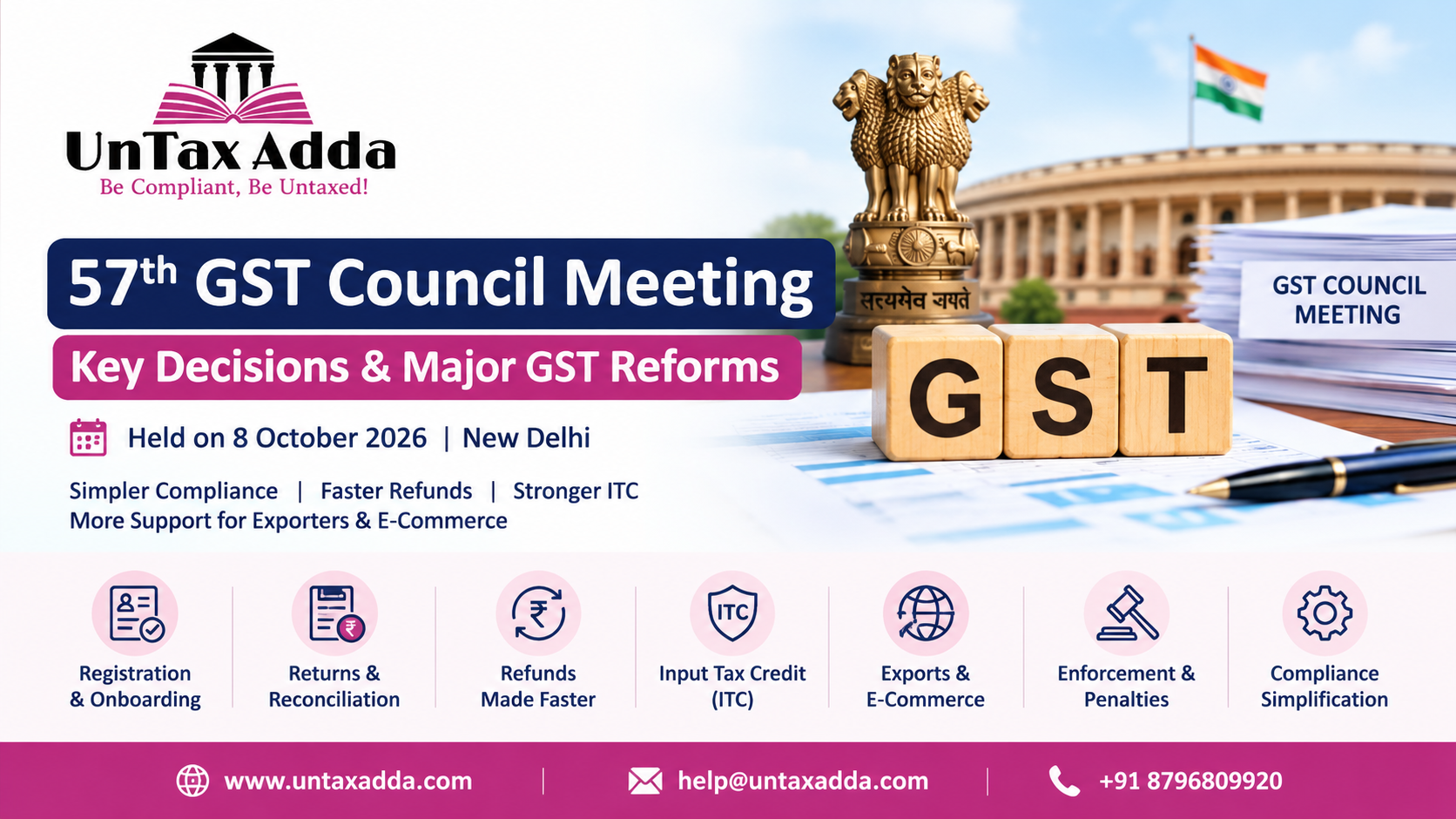
The 57th GST Council Meeting was held in New Delhi on 8 October 2026. The meeting focused mainly on simplifying GST compliance, improving the refund mechanism, rationalising enforcement, strengthening Input Tax Credit (ITC) provisions and making GST easier for businesses and taxpayers.
Importantly, no GST rates were changed in this meeting. The Council focused on procedural and administrative reforms, while rate-related matters are proposed to be considered separately at a dedicated meeting.
Major Highlights of the 57th GST Council Meeting
1. Faster and Easier GST Registration
The GST registration process is proposed to become more automated and taxpayer-friendly.
Currently, low-risk applicants and certain applicants with output tax liability on supplies to registered persons up to Rs. 2.5 lakh per month can receive registration through an automated process within three working days. The Council noted that 61% of registrations are already being processed through the automated route.
The registration application will also be redesigned so that applicants see only the fields applicable to them and can understand the purpose of each document required.
2. Automatic Approval of Certain GST Amendments
Certain changes in GST registration details are proposed to be accepted automatically.
These include changes relating to:
(a) Trade name;
(b) Director or partner; and
(c) Additional place of business.
This reform is expected to reduce unnecessary delays and officer intervention for routine amendments.
3. Major Reform in GST Returns and ITC
The Council has proposed improvements in return filing and reconciliation. Where a seller reduces an amount already reported, the change will flow through the sales statement to the buyer who has claimed ITC. Corrections relating to earlier periods will also be permitted, including correction of an incorrectly entered buyer GSTIN.
The Invoice Management System (IMS) will be used for settling credit, with the buyer's accepted credit flowing into the return.
4. GST Refunds to Become Faster
One of the important proposals relates to GST refunds.
The time limit for acknowledgement of a refund claim is proposed to be reduced from 15 days to 10 days. If neither an acknowledgement nor a deficiency memo is issued within 10 days, the refund claim will be treated as acknowledged.
Further, the system will sanction 90% of the refund claim based on risk assessment, and the order is proposed to be issued within three working days of acknowledgement. Refund of excess balance lying in the electronic cash ledger will also become fully automatic.
5. Important Changes in Input Tax Credit
The Council has proposed wider availability of ITC for certain business expenses.
ITC will be available on:
(a) Health and life insurance taken for employees;
(b) Telecommunication towers;
(c) Pipelines laid outside a factory;
(d) Free samples; and
(e) Stock written off on expiry of shelf life where the law requires destruction of the goods.
6. Protection of Genuine Buyers
A Committee of Officers will examine the issue of protecting genuine buyers who:
(a) Hold a proper invoice;
(b) Have actually received the goods; and
(c) Have paid their supplier in full.
The Committee is expected to complete its study within three months, after which the matter will be placed before the GST Council. This proposal could be important for businesses facing ITC-related difficulties because of supplier-side issues.
7. Refund of ITC under Inverted Rate Structure
A significant proposal concerns refund of accumulated ITC under an inverted rate structure. Refund of eligible input services will be available for credit availed on or after 1 November 2026. The exclusion of tax paid on plant and machinery from refund is also proposed to be removed.
Refund relating to plant and machinery will be calculated at 1/60th of the credit for each month and will be available for credit availed on or after 1 April 2027.
8. Easier GST Cancellation and Closure
GST registration cancellation is proposed to become automated in stages, beginning with smaller taxpayers. The final return will form part of the closure application, eliminating the need for a separate subsequent step.
Where registration has been suspended or cancelled because of a missing return or missing bank details, the system will restore the registration once the taxpayer complies with the requirement.
9. Simplified Filing for Small B2C Taxpayers
An optional scheme has been approved in principle for taxpayers having turnover up to Rs. 5 crore who supply only to consumers.
Under the proposed scheme:
(a) GST return will be filed once in a year; and
(b) Tax will be paid quarterly.
The detailed framework and necessary amendments will be considered at the next GST Council meeting.
10. Less Physical Checking of Goods in Transit
The Council has proposed restrictions on unnecessary physical inspection of goods in transit.
A vehicle may be stopped only on the basis of specific intelligence, with prior authorisation by an officer not below the rank of Joint Commissioner.
Only the source State and destination State will be permitted to inspect the goods. States through which the goods merely pass will not be able to stop the vehicle.
11. Changes in GST Arrest and Prosecution Provisions
(a) A major proposed enforcement reform is the removal of the power of arrest under GST.
(b) The prosecution threshold is proposed to increase from Rs. 1 crore to Rs. 5 crore.
(c) The minimum punishment is also proposed to be removed, leaving punishment to judicial discretion.
(d) The general penalty is proposed to be reduced from Rs. 25,000 to Rs. 10,000 where no specific penalty is prescribed.
12. Relief for Exporters and E-Commerce Sellers
The Council has proposed several measures to facilitate exports of services.
Services provided in India on goods belonging to foreign clients—such as testing, repair, certification, research and processing—will qualify as export of services even when the goods do not leave India.
Indian businesses serving foreign clients through their own overseas branches will also receive export benefit under the proposed changes.
Small sellers using e-commerce platforms will also get greater flexibility in obtaining GST registration in other States by using an e-commerce operator's warehouse as their principal place of business, subject to the proposed conditions.
No GST Rate Change in the 57th Meeting
One of the most important points for taxpayers is that GST rates were not changed at the 57th GST Council Meeting.
The meeting focused on addressing procedural difficulties, inconsistencies and ambiguities that remained after the previous rate exercise. Rate-related matters are proposed to be taken up separately at a dedicated meeting.
Conclusion
The 57th GST Council Meeting 2026 marks an important move towards a more automated and taxpayer-friendly GST system.
The major proposals cover GST registration, return filing, ITC, refunds, cancellation, litigation, enforcement, exports and e-commerce.
The overall objective is to reduce unnecessary manual intervention and make GST compliance faster and simpler.
However, taxpayers should note that several of these proposals will require necessary amendments, notifications or detailed rules before they become operational. Therefore, businesses should wait for the relevant legal notifications before implementing the proposed changes.
Source: Note on Outcomes of the 57th Meeting of the GST Council, New Delhi, 8 October 2026.