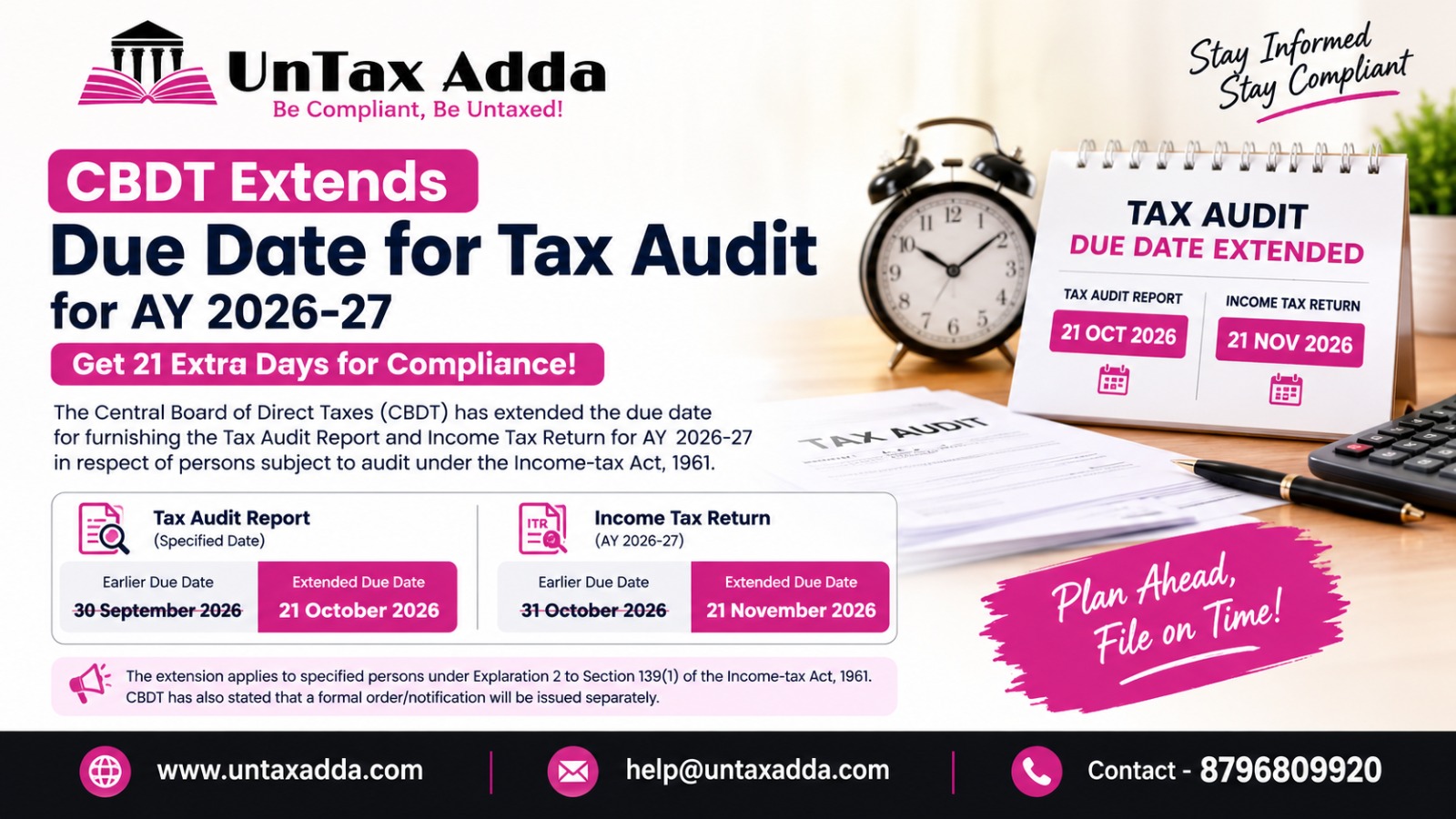
CBDT Extends ITR Filing Due Date for Tax Audit Cases for AY 2026-27
The Central Board of Direct Taxes (CBDT) has announced an important extension for the ITR filing due date AY 2026-27 in cases where the taxpayer is required to get its accounts audited under the Income-tax Act, 1961.
According to the press release dated 28 September 2026, the due date for furnishing the return of income has been extended from 31 October 2026 to 21 November 2026. The corresponding specified date for furnishing the audit report has also been extended from 30 September 2026 to 21 October 2026.
What has been extended?
The extension announced by CBDT can be summarised as follows:
|
Particulars |
Earlier Due Date |
Extended Due Date |
|
Tax Audit Report |
30 September 2026 |
21 October 2026 |
|
Income Tax Return – AY 2026-27 |
31 October 2026 |
21 November 2026 |
The extension applies to the specified persons referred to in Explanation 2 to Section 139(1) of the Income-tax Act, 1961, i.e. persons whose accounts are required to be audited under the Income-tax Act and who fall within the relevant category prescribed for the audit-related return due date.
Why is this extension important?
Taxpayers covered by tax audit provisions are required to complete their audit and furnish the prescribed audit report before filing their Income Tax Return.
The extension therefore provides additional time for:
- Completion of tax audit;
- Preparation and furnishing of the tax audit report;
- Reconciliation of books of account with financial statements;
- Verification of TDS/TCS and other tax credits;
- Compilation of information required in the applicable ITR;
- Review of tax deductions and disallowances; and
- Final filing and verification of the Income Tax Return.
For AY 2026-27, the Income Tax Department has clarified that tax audit reports continue to be furnished using the existing forms under the Income-tax Act, 1961, including Form 3CA/3CB and Form 3CD, as applicable.
Who will benefit from the extension?
The extension is particularly relevant for taxpayers whose accounts are required to be audited under the Income-tax Act, 1961, such as eligible businesses and professionals falling within the tax-audit provisions.
However, this extension should not be understood as a general extension for every taxpayer filing an ITR for AY 2026-27.
Taxpayers who are not covered by the audit category should continue to follow the due date applicable to their particular category and ITR form.
Important: AY 2026-27 vs Tax Year 2026-27
Taxpayers should also be careful about the transition between the Income-tax Act, 1961 and the Income-tax Act, 2025.
For FY 2025-26 / AY 2026-27, the return is governed by the Income-tax Act, 1961. The Income Tax Department has also clarified that the existing tax-audit forms are applicable for this assessment year.
The new framework under the Income-tax Act, 2025 applies to the subsequent tax-year regime, subject to the applicable transition provisions.
Taxpayers should not wait until the extended deadline
Although CBDT has granted additional time, taxpayers covered by tax audit should ideally use the additional period to complete their compliance rather than postponing the entire process until November.
Businesses and professionals should ensure that their books, bank statements, GST data, TDS/TCS records, fixed asset schedules, loans, investments and other relevant documents are properly reconciled before finalisation of the tax audit report.
Particular attention should also be given to the information required for Form 3CD, as discrepancies between the books, GST returns, TDS statements, financial statements and ITR can result in avoidable compliance issues.
Key takeaway
The CBDT's latest announcement provides the following revised timeline for specified tax-audit cases for AY 2026-27:
Tax Audit Report: 21 October 2026
Income Tax Return: 21 November 2026
The CBDT has stated that a formal order/notification will be issued separately. Taxpayers and professionals should therefore also refer to the formal notification once issued for the precise statutory details and scope of the extension.
Quick Compliance Checklist
Before filing the ITR, taxpayers covered by tax audit should ensure:
(a) Books of accounts are finalised
(b) Tax audit is completed
(c) Form 3CA/3CB and Form 3CD are furnished, as applicable
(d) GST turnover and books are reconciled
(e) TDS/TCS credits are reconciled
(f) Bank accounts and other financial records are reconciled
(g) Depreciation and fixed assets are verified
(h) Applicable tax deductions and disallowances are reviewed
(i) Tax liability is computed and taxes are paid
(j) ITR is filed and duly verified within the revised deadline
Disclaimer: This article is intended for general information and educational purposes only. The exact due date and compliance requirements may depend on the taxpayer's status and applicable provisions. Taxpayers should refer to the formal CBDT notification/order and applicable provisions before taking compliance decisions.
CA Sartaj Fatima
New Delhi