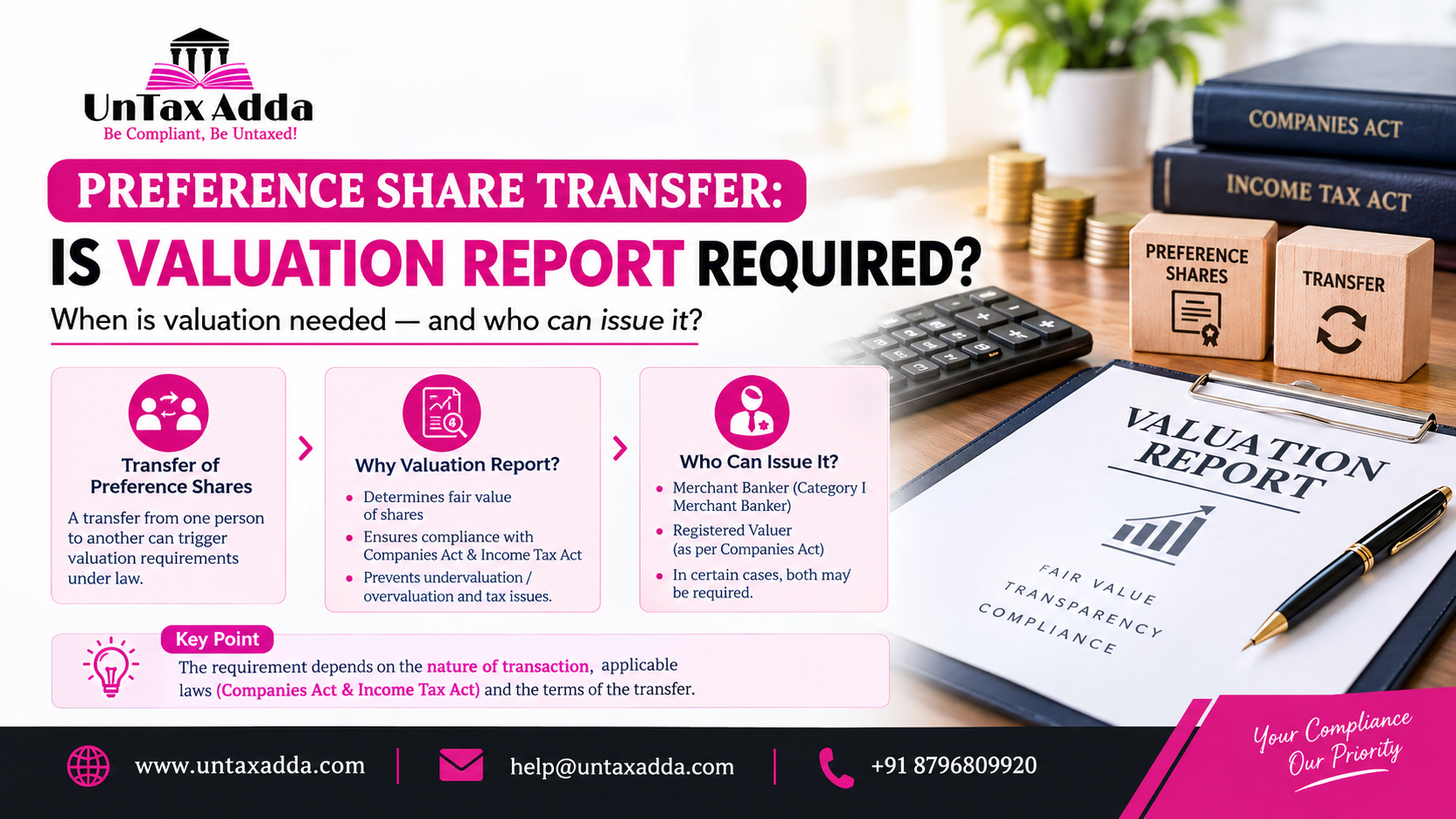
1) Requirement of Valuation Repor
Yes. I have checked the current Companies Act, 2013 framework and the Income-tax Act, 2025 / Income-tax Rules, 2026, which are particularly relevant because, as of September 2026, the Income-tax Act, 2025 is in force from 1 April 2026.
Below is an opinion you can adapt while considering that whether valuation report is required at the time of transfer of preference shares or not. The below opinion has been drawn assuming that:
- the securities are preference shares;
- the preference shares are unquoted/unlisted;
- transfer is by way of sale, not gift;
- transferor and transferee are both resident in India;
- the preference shares are issued by an Indian company;
- there is no special restriction in the Articles/terms of issue which prohibits or regulates the transfer.
2) Issue for consideration
The issue is whether, in case of transfer of preference shares by one Indian resident to another Indian resident:
A. a valuation report is mandatorily required;
B. if valuation is required, whether it should be obtained from:
ü a SEBI-registered Merchant Banker;
ü a Registered Valuer under the Companies Act, 2013; or
ü both;
C. what are the implications under the Companies Act, 2013 and the Income-tax Act, 2025.
My considered view is as follows:
|
Issue |
Position |
|
Companies Act valuation report for mere transfer |
Not mandatory merely because preference shares are being transferred |
|
Registered Valuer under Companies Act |
Not ordinarily required for secondary transfer |
|
Merchant Banker valuation |
Not mandatory merely under Companies Act |
|
Income-tax FMV |
Must be determined for tax purposes where section 79/92 applies |
|
Income-tax valuation report |
For unquoted preference shares, Rule 57 says assessee may obtain report from Merchant Banker or Accountant |
|
SEBI Category-I Merchant Banker |
Acceptable |
|
Chartered Accountant/“Accountant” |
Acceptable, subject to statutory eligibility |
|
Registered Valuer under Companies Act |
Not the prescribed valuer for this particular Income-tax valuation |
|
Both Merchant Banker + Registered Valuer |
No statutory requirement to obtain both |
|
FEMA valuation |
Generally not applicable where both transferor and transferee are persons resident in India |
|
Practical recommendation |
Obtain one defensible FMV report from a SEBI Category-I Merchant Banker or eligible Chartered Accountant, particularly where transaction value differs materially from FMV |
3) Companies Act, 2013 | Provisions related to Transfer of Preference Shares
Section 44 – Nature of Shares or Debentures
Section 44 of the Companies Act provides that the shares or other interest of any member in a company are movable property and are transferable in the manner provided by the Articles of the company.
Preference shares are also "shares" for the purposes of the Companies Act.
Therefore, a transfer of preference shares is fundamentally a secondary transfer between shareholders, rather than an issue of fresh securities by the company.
Section 56 – Transfer and transmission of securities
Section 56(1) provides that a company shall not register a transfer of securities unless a proper instrument of transfer, in the prescribed form (i.e. Form SH-4), duly stamped, dated and executed by or on behalf of the transferor and transferee, is delivered to the company within 60 days from the date of execution, along with the relevant security certificate/letter of allotment, as applicable.
For physical securities, the prescribed transfer form is Form SH-4 under the Companies (Share Capital and Debentures) Rules, 2014. SH-4 specifically permits transfer of different classes of securities and requires the consideration and details of the securities to be stated.
Therefore, for physical preference shares:
Generally, the following should be completed:
- duly executed SH-4;
- appropriate stamp duty (i.e. 0.015% × consideration basis);
- original preference share certificate;
- consideration details;
- Board approval/registration as required by the Articles and applicable law;
- updating of Register of Members;
- endorsement/new certificate, as applicable.
The company is required to deliver the certificate in case of transfer within one month from receipt of the instrument of transfer.
Does Section 56 require valuation?
Section 56 does not prescribe that a valuation report from a Registered Valuer or Merchant Banker must accompany a normal secondary transfer of shares.
The statutory requirements under Section 56 are transfer instrument; execution; stamping; delivery to the company; share certificate/letter of allotment; registration of transfer.
There is no general requirement under Section 56 that every transfer of preference shares must be supported by a valuation report.
4) Income-tax Act – this is where valuation becomes important
This is the more significant issue.
Since 1 April 2026, the Income-tax Act, 2025 is in force. The corresponding provision is now Section 79, replacing the earlier Section 50CA of the Income-tax Act, 1961.
79 of IT Act, 2025/ 50CA of IT Act, 1961 | Special provision for full value of consideration for transfer of share other than quoted share.
Where the consideration received or accruing as a result of the transfer by an assessee of a capital asset, being share of a company other than a quoted share, is less than the fair market value of such share determined in such manner as may be prescribed, the value so determined shall, for the purposes of section 48, be deemed to be the full value of consideration received or accruing as a result of such transfer:
Provided that the provisions of this section shall not apply to any consideration received or accruing as a result of transfer by such class of persons and subject to such conditions as may be prescribed.
Explanation.—For the purposes of this section, "quoted share" means the share quoted on any recognised stock exchange with regularity from time to time, where the quotation of such share is based on current transaction made in the ordinary course of business.
Does Section 79 apply to preference shares?
Yes, in my view, where the preference shares are unquoted. The wording is:
"share of a company other than a quoted share". Hence, it is not restricted to equity shares only.
Further, the Income-tax Rules expressly distinguish:
- unquoted equity shares; and
- unquoted shares and securities other than equity shares.
Preference shares fall into the second category.
The current Income-tax Rules, 2026 prescribe the valuation mechanism for unquoted shares/securities other than equity shares.
Rule 57 – Valuation of Unquoted Preference Shares
This is the most important provision for question into consideration.
Under Rule 57 of the Income-tax Rules, 2026, the FMV of:
unquoted shares and securities, other than equity shares in a company, which are not listed on a recognised stock exchange is the:
price it would fetch if sold in the open market on the valuation date.
The Rule further provides that the assessee may obtain a report from a merchant banker or an accountant in respect of such valuation.
Therefore, for unquoted preference shares:
The prescribed tax valuation is essentially:
Open Market Value / Fair Market Value
and the assessee has the option of obtaining a valuation report from:
(a) Merchant Banker; OR
(b) Accountant. (As per section 515(3)(b) of the Income-tax Act, 2025, it means a Chartered Accountant holding a valid Certificate of Practice, subject to the statutory exclusions/eligibility requirements.)
Therefore, for this purpose, an eligible practising Chartered Accountant can provide the relevant valuation report.
5) Is a Registered Valuer under Companies Act required?
No—not for this particular Income-tax valuation.
This is where there is often confusion. The Companies Act has its own concept of a Registered Valuer under Section 247. But Rule 57 of the Income-tax Rules, 2026, for unquoted preference shares, specifically refers to merchant banker or accountant.
It does not say "registered valuer under Section 247 of the Companies Act."
Therefore, if your question is:
"Should we obtain a Registered Valuer report under the Companies Act for the transfer of unquoted preference shares?"
My answer is:
No, there is no general statutory requirement to obtain a Companies Act Registered Valuer report merely for the secondary transfer.
6) Is Merchant Banker report mandatory?
Strictly speaking, no. The wording of Rule 57 is significant:
"the assessee may obtain a report from a merchant banker or an accountant..."
The word "may" indicates that obtaining the report is not itself an absolute statutory condition for every transfer. However, the underlying FMV requirement is mandatory for applying Section 79. So there are two different propositions:
Proposition 1
FMV determination is legally relevant/required.
Proposition 2
A formal Merchant Banker valuation report is not mandatory in every case.
The Rule permits the assessee to obtain documentary professional support for that FMV.
Merchant Banker OR Accountant – not bothFor an unquoted preference share transaction, the Income-tax Rules contemplate:
Merchant Banker OR Accountant.
There is no requirement that both reports must be obtained.
Therefore:
Option A- SEBI Category-I Merchant Banker valuation report OR Option B- Eligible Chartered Accountant valuation report is sufficient from the perspective of the specific Rule.
The Income-tax Rules define "merchant banker" as a Category-I merchant banker registered with SEBI.
7) What is my practical recommendation?
Although the law does not make the report mandatory in every case, I would recommend obtaining a valuation report where:
- transaction value is significantly below/above book value;
- preference shares carry a substantial redemption value;
- preference shares carry cumulative dividend;
- preference shares are convertible;
- preference shares have preferential liquidation rights;
- company has substantial assets;
- company owns immovable property;
- transaction is between related/connected persons;
- transaction value is materially different from the last issue price;
- transaction value is likely to be scrutinised by the Income-tax Department;
- seller wants strong support for Section 79 of IT Act, 2025;
- buyer wants protection under Section 92(2)(m) of IT Act, 2025.
8) Valuation date
This is also important. Under Rule 56 of the Income-tax Rules, 2026, the valuation date for Section 79 is:
“the date on which the capital asset, being share of a company other than a quoted share, is transferred.”
For Section 92, the valuation date is the date on which the property/consideration is received, as prescribed.
Thus, you should ideally have the valuation report linked to the actual relevant valuation date, rather than relying on an old valuation report.
9) Registered Valuer vs Merchant Banker vs CA
|
Professional |
Companies Act – secondary transfer |
Income-tax – unquoted preference shares |
|
Companies Act Registered Valuer |
Not ordinarily mandatory |
Not specifically prescribed by Rule 57 |
|
SEBI Category-I Merchant Banker |
Not ordinarily mandatory |
Permitted |
|
Practising CA/Accountant |
Not ordinarily mandatory |
Permitted |
|
Both Merchant Banker + Registered Valuer |
Not required |
Not required |
10) Relevant Case Law
MADRAS HIGH COURT — The Principal Commissioner of Income Tax-1 v. Boppudi Logistics Private Limited,
AY 2011-12 | T.C.A. No. 117 of 2026 | Order dated 11.08.2026
Unquoted Preference Shares — CA Valuation Report Accepted
Section 50CA of IT Act, 2025 applies to the transfer of an “unquoted share” (defined as a share which is not a quoted share). Rule 11UAA specifically provides that the FMV of such shares for Section 50CA purposes shall be determined as per the relevant sub-clause of Rule 11UA(1)(c).
For unquoted preference shares, the FMV is the estimated open-market price. The assessee may obtain a report from a merchant banker or an accountant (Chartered Accountant) to support the valuation. The Madras High Court has upheld the validity of a Chartered Accountant’s report for unquoted preference shares under this rule.
CONCLUSION
On the basis of the provisions of the Companies Act, 2013, the Income Tax Act, 2025 and the Income Tax Rules, 2026, and subject to the assumptions and qualifications stated herein, our opinion is as follows:
- A transfer of existing preference shares from one resident in India to another resident in India constitutes a secondary transfer of securities and is principally governed by Section 56 of the Companies Act, 2013, read with the applicable rules, the Articles of Association of the issuing company and the terms governing the preference shares.
- Section 56 of the Companies Act, 2013 does not prescribe a general requirement that every secondary transfer of preference shares must be supported by a valuation report. Accordingly, a valuation report of a Registered Valuer under Section 247 (i.e. Valuation by Registered Valuers) of the Companies Act, 2013 is not ordinarily mandatory merely for effecting such transfer.
- The valuation requirements applicable to fresh issue/preferential allotment of securities under Section 62 of the Companies Act, 2013 and the applicable rules should not be equated with the requirements applicable to a transfer of already issued preference shares between two existing/resident persons.
- However, the transfer has significant income-tax implications. In the case of unquoted preference shares, Section 79 of the Income-tax Act, 2025 provides for substitution of the prescribed fair market value as the full value of consideration for capital-gains purposes where the actual consideration is lower than such fair market value.
- Further, Section 92(2)(m) of the Income-tax Act, 2025 may have implications for the transferee where the preference shares are acquired for consideration lower than their prescribed fair market value, subject to the applicable statutory exceptions.
- Under Rule 57 of the Income-tax Rules, 2026, the fair market value of unquoted shares and securities other than equity shares is based upon the price which such shares/securities would fetch if sold in the open market on the valuation date. The Rule permits the assessee to obtain a valuation report from a Merchant Banker or an Accountant (CA).
- Accordingly, in the case of unquoted preference shares, the Income-tax Rules, 2026 do not require valuation reports from both a Merchant Banker and a Registered Valuer. A report from either an eligible SEBI Category-I Merchant Banker or an eligible "Accountant" within the meaning of the Income-tax Act, 2025 may be obtained as appropriate supporting evidence of fair market value.
- A Registered Valuer under the Companies Act, 2013 is not specifically prescribed by Rule 57 for valuation of unquoted preference shares for the purposes referred to above. Consequently, obtaining a Companies Act Registered Valuer's report is not, by itself, a statutory prerequisite for the secondary transfer.
- Nevertheless, considering the possible application of Section 79 to the transferor and Section 92(2)(m) to the transferee, it is advisable, particularly in the case of a material transaction or a transaction between related/connected parties, to obtain a contemporaneous valuation report from either a SEBI Category-I Merchant Banker or an eligible Chartered Accountant and to maintain the valuation workings and supporting financial information on record.
- Where both the transferor and transferee are persons resident in India for FEMA purposes, the FEMA pricing restrictions applicable to transfers involving a person resident outside India are ordinarily not attracted. Therefore, FEMA does not independently require a Merchant Banker valuation for the proposed resident-to-resident transfer.
- The transfer should additionally comply with the Articles of Association, terms of issue of the preference shares, applicable transfer restrictions, execution and delivery requirements under Section 56, applicable SH-4 requirements in case of physical securities, dematerialisation/depository requirements where applicable, and applicable stamp-duty provisions.
Accordingly, our considered view is that a valuation report from both a Merchant Banker and a Registered Valuer is not legally required for the proposed resident-to-resident transfer of unquoted preference shares. For income-tax risk management, however, obtaining one contemporaneous valuation report from either a SEBI Category-I Merchant Banker or an eligible Chartered Accountant is recommended, particularly where the consideration is not demonstrably at or above fair market value.
CA Rakesh Malhotra
New Delhi